How to write a great player profile that helps you find a DnD group

Published March 30, 2026 by Groupfinder Team

Overview

Why your bio matters

If you want to find a dungeons and dragons group https://groupfinder.eu/list, you should keep in mind, that the player to DM ratio is heavily skewed against you. Most DMs receive up to 10 applications per player seat. Having a great player profile will help you stand out and will create a good first impression. Finding a dnd group https://groupfinder.eu/library/how-to-find-a-dd-group-online-the-ultimate-guide-for-2026 has a lot in common with online dating. Leaving a good first impression, seeming reliable, trustworthy and willing to commit - these are all important either on a dating profile or when creating a player profile. If your thinking is “If they want to know more about me, they will ask.” It is very likely that they won’t. Remember that you are fighting an uphill battle. Groups aren’t really facing a shortage of players and you need to use any tool and skill you have to display yourself as someone they want to have in their group. Ofcourse it will be a balancing act - introducing yourself in as much detail as possible, while not ending up with more paragraphs than a book.

The anatomy of a player bio

Preferences, playstyle, experience, logistics, reservations and much more - all of these are things that help a Dungeon Master find the right person to even start a discussion with. If your profile introduces you on a superficial level: “Hello, I am Holger and I would love to find a group to play with.” Then you aren’t really saying much (other than your name, which is a good start).

This could be you.

Playstyle

Are you someone who enjoys roleplay above anything else? Or do your eyes light up whenever the DM tells you all to “Roll Initiative”? Perhaps you find enjoyment in both deep character interactions, social encounters but when need be, have a good understanding of how combat works and enjoy casting fireball too close to your fighter (It happens…). If you know what you’d prefer in a game, be sure to explain which core pillars of the game you enjoy - a game that is all about dungeon crawling and heavy combat situations will not be something a roleplay-focused player will find as enjoyable as one with political intrigue, social manipulation or characters with a deep and devious backstory. You can pick and add various tags to go with your post. Groups filtering players by “Roleplay focused” will find you, if your profile has that tag added to it. Adding tags in addition to describing your preferences in the bio is a powerful tool.

Experience level

Have you played Dungeons & Dragons before? If not - don’t feel discouraged. There are new players discovering DnD every day and a newcomer is not a rare sight. Whether you've played the D&D 2014 rules version or are a newcomer starting fresh with the 2024 revised edition, tell the reader which version you are interested in playing. It can be both, if you are not overly picky. Many Dungeon Masters, either new themselves or veterans of the hobby, happily welcome new players to their tables. If they are just starting out with DnD and bravely decided to take up the role of the DM immediately (These players are heroes), they are very likely to enjoy other players with less experience. This is not to say that veterans are not suitable for their games, if the ones with experience are capable and willing to explain, guide and correct (when needed/asked). Nobody wants a “rules lawyer” player who insists on “Um Actually…” whenever the DM calls for a Perception roll, although Investigation might’ve been more appropriate. There are also veteran DMs who enjoy hosting newcomers at their games. Making sure that they understand the basics of the game, the core elements and grow them into capable players who will understand the game and how to be a great player.   Having previous experience is not a requirement. But being honest about it is a must. You are unlikely to not get “caught” if you attempt to overplay your experience. And that will just leave a bad impression of you.

Logistics and location

Whether you are looking for an online game, or seeking for an in-person at-a-table group, make sure to be specific. For online games, mark down your timezone. This will help you find a game, that won’t start after midnight, or early in the morning (Unless this fits well with your schedule). Joining a group where for other players it is 6PM, but you just woke up and are still working through your bowl of cereal, might not be the best fit.
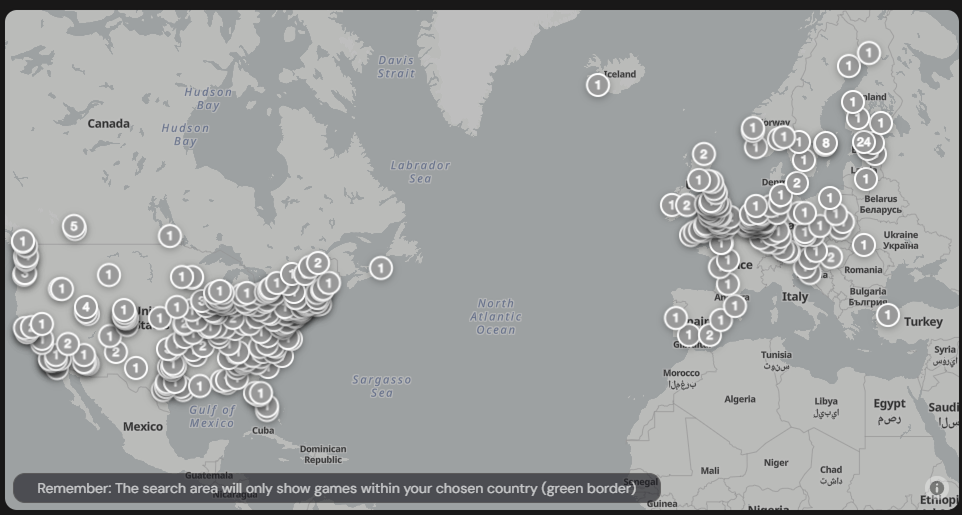
There are players from all across the world (also in regions that did not fit on this map. This is not the entire world, even though some bands arranging their"World Tour" see it that way)
If you are trying to join an in-person game, mark your location. This isn’t to say, that give out your home address - don’t do that. There is no reason for that and putting specific personal information out there is a bad idea in general. Pick the closest town or city to you. On Groupfinder the search isn’t restricted to specific locations, but on a radius. If a DM, looking for players is searching around their area and your town falls into their search radius - they will find you.   If you have a specific schedule or time prerefences - mark those down. If you can only play from 6PM to 11PM on Wednesdays - make sure that this is clear to understand and see. You can even double down on timezones and repeat what timezone your 6PM is in.

A fun fact

You are not just timezones, experiences and preferences. You are a human being with a personality and thoughts. Perhaps you have a character concept https://groupfinder.eu/library/covering-the-basics-making-a-character that you would love to try out. A ranger that is afraid of trees, a wizard that is illiterate or a rogue that hates doing crime. Write a short introduction of that character - this will also give the DM an understanding on how you would approach the game. If you are not someone, who creates characters to store in your drawer, then this is perfectly acceptable. Many players create a character to fit the world/game they are going to join and craft it based on the lore and history of it. In addition to a pre-created character, you can list books, shows, movies that you enjoy (that could be seen as your theme or playstyle preferences). This will describe your type of fantasy to anyone reading. Love Discworld? Write it down. Not overly excited about lovecraftian horrors - understandable.

Weak versus good bio: a comparison

While these should be taken with a grain of salt, here are two approaches - one illustrating a superficial approach and one that shows that you put in some effort. That effort will be seen as a “green flag”. You show yourself as someone who is actually willing to put in the work when it comes to a game or crafting a great character that enhances the game. Weak bio “I want to play a rogue or a ranger. I’m free on the weekends.” Good bio “Hello. I am a 3-year veteran looking for a bi-weekly group on either Thursdays or Fridays (available after 6PM (GMT)). If life doesn’t unexpectedly come in the way, I am reliable and can commit to consistently showing up to on the game night. I enjoy character-driven games and social intrigue. In no way against combat but I would prefer to find a game with a stronger focus on the roleplay side of things. Very okay with games where our characters can die in reasonable scenarios. I am a huge fan of The Stormlight Archive series and The Kingkiller Chronicle.” These are general examples - not something you should be imitating almost word for word. But should be taken as a directing guide when you are creating or updating your profile.

You are all set now.

Ready to be invited?

Stop waiting for a miracle. Create your player profile now https://groupfinder.eu/userform and let Dungeon Masters find you. Don’t forget to bump your post every day. You will see the button on your profile. Clicking on the bump button will move your profile to the top, increasing the odds that your profile stands out and gets noticed.

Other entries

DnD Looking for Group: How to find your next table
Guides & How-to

DnD Looking for Group: How to find your next table

Guides
The “LFG” struggle is real. How do you find a group to play with in 2026 “LFG D&D 5E”, “LFP D&D 2014/2024 5E”, “LFG Dungeons & Dragons” - it is very likely that you have seen (or even posted) such messages in various places. LFG, or Looking for Group, is the common acronym to indicate that you are looking for a table to join. The opposing acronym is LFM - Looking for Members. Posting these messages will wear you down eventually. Are there really no groups that have room for you? Is there something obvious that you are perhaps missing? Is the hobby not meant for you? It is natural to feel worn down by either rejection or just silence. You see a group that is looking for players, you reply and you get nothing back. Playing Dungeons & Dragons should feel like fun. Because it is fun. Find the right group that fits your style and you will absolutely fall in love with the game and look forward to every session. But. You have to get there first. You need to find a group of players to take you in and only then, can you take the next steps. Reddit, Discord, Facebook or a dedicated platform? When you are looking for a dnd group, you are faced with various different paths to take. They all have their cons and pros. Lets take a look at some of the more popular approaches: The subreddit spam Reddit has been a reliable all-inclusive platform for a long time now. With a massive amount of users all over the world covering various different topics, themes, questions, experiences and interests - it is safe to say, that reddit has everything. But including that everything, you might run into a lot of “noise”. Pros: A lot of users making many posts every day. Global platform connecting you to various people all across the globe. Cons: The noise. An active subreddit will see multiple posts every hour. Your post might get immediately covered by other redditors’ posts. Filtering the posts to find something relevant to you will be difficult, as it is all text-based and with no detailed search functions. Finding a group that is focused on a specific theme or topic will be a chore. The Discord discourse As a platform for messaging and being involved with various communities - there isn’t a good alternative to Discord. Different communities have various versions of #looking-for-group channels. And as clustered as Discord is, with everyone starting their own server, gathering users and growing a community, you are either locked to a few LFG channels - or you have to find a ton of various community servers to join, to share your post with as many pairs of eyes as you can. Pros: It is an instant messaging platform. You post - it gets sent. You get a reply, it happens instantly. And once you find a group to join, you don’t have to look further, as most likely further communication will continue on Discord. Cons: You need to know where to go. There isn’t a one-stop-shop server that gets your message out to everyone in the hobby-space. It also lacks a search functionality beyond basic text search. Unless the server you have found separates games by theme, type, timezone or some other parameter - you are usually stuck with a single channel to post and search. The Facebook fatigue You most likely already are on Facebook. Either you have an account that is collecting dust, or you use it for messaging. And similar to Discord, there are tons of various D&D LFG groups to find, join and post in. You just have to find the right one, get your join request approved and get posting. Pros: Once you find a group that fits your search criteria, you can post your message. And have people either leave a comment or message you directly. Keep in mind, that messages from users who you are not connected with will be filtered to a separate mailbox. Be sure to check there, if you are waiting for a reply. Cons: Just like the other methods listed above, Facebook also falls short when it comes to searchability. And compared to Reddit or Discord, the search functionality is even more limited. It was never designed for that. You also need to find an appropriate Facebook group to join. One that still has active users and has not been abandoned yet. The Groupfinder gateway And then there is Groupfinder. A dedicated platform for your LFG needs. Free to use, with users all across the world and a simple user interface to get you going. While other platforms are, at the end of the day, messaging boards - Groupfinder has been built from the ground-up to serve a specific purpose (You won’t be selling a lawnmower here any time soon). You are here to find a dungeons and dragons group. Pros: Filtering. Finding a group (or other players) is easy with various filtering options. Looking for an online dnd group? Limit your search results to a specific timezone. Whether you are on the east coast, central Europe, or even in Australia - you can manage who’s posts you are shown. /images/general-media/1774999635_UxGFgbcv.pngThe filtering system will help you narrow down your search Or if you are trying to find a local, in-person game - you can use the map filter to pick a specific location on the map, adjust the search radius and only be shown the groups that match your specified area. In addition to timezones, you can use the tags. You can only view groups who have added various predefined tags to their post. Looking for a game that is suitable for a newcomer - “Beginner friendly”. Want to play over messages - “Play by post”. Interested in games that have a spooky theme - “Horror”. Take a look at the various tags that you can use to filter the posts. Are you looking for a game that follows the 2014 ruleset? Pick “Dungeons & Dragons 5E”. Or are you ready to switch over to the newer rules? - “Dungeons & Dragons 5.5E (2024)”. Even if you are looking for games for another game system, like Daggerheart, Pathfinder, Shadowrun, Mothership or Savage Worlds - use the game system filter. (Read more about the popularity of alternative TTRPG systems in this article) Not currently looking to join a paid game? Understandable - you can use the “Paid game” switch to filter out all the games run by professional GMs. Cons: The platform is still growing and more people are still discovering it. How to increase the odds of your post succeeding? While there isn’t a specific and guaranteed approach that is bound to get you into a group within 5 minutes of posting. You can still follow a few suggestions to increase the odds. Who are you and what do you want?  This might sound like a line from a cheesy detective movie - but it holds some truth. Writing a compelling and descriptive profile bio will give you a massive advantage Tag appropriately. Some groups search for players via tags. If you don’t have any added to your profile, you are immediately cutting yourself out of their search results. Don’t go overboard and add all the tags. Pick only the ones that represent your preferences the best. Share your profile. All the platforms listed above are messaging boards after all. If you spot a group or players thinking about forming a party - post your profile link. Instead of sending them a wall of text, you now have a page that describes who you are, what games you are looking for, what your timezone is and displays you as someone willing to go the extra mile. Bump yourself. Bumping (Bring up my post) is how we have eliminated the constant message spam. Instead of returning every day or two to write up a new post to introduce yourself, you can take your current profile and just click the button on the right side of your cover image. That will bump your post to the top of the listings, completely refreshing it’s position. Stop wearing yourself thin Instead of spending all that time posting on various different platforms. And then doing a second lap of checking for responses - post your profile and find your dnd group.

Read more

TableForge
Tools & Platforms

TableForge

Virtual tabletop (VTT)
Subscription
TableForge is an AI-powered virtual tabletop that runs your Dungeons & Dragons 5e games for you. Create a character, gather your party, and play through a living fantasy world guided by an AI Dungeon Master that narrates the story, runs combat, and reacts to whatever you decide to do. Every adventure generates its own characters, locations, encounters, and battle maps, so you can go from "let's play tonight" to actually playing in a few minutes. No DM, no prep, no scheduling marathon. /images/general-media/1785090300_1dWltGXR.png Full description TableForge started with a familiar problem: a group of friends who wanted to play D&D together but lived in different cities and could never get their calendars to line up. No regular DM, no reliable session night, just a game everyone wanted to play and no practical way to play it. TableForge is built for exactly that situation, whether you're a full party, two friends grabbing an hour, or one person who wants to disappear into a story alone. You create a character, start (or join) a campaign, and play in natural language. The AI Dungeon Master sets the scene, voices the NPCs, calls for rolls, runs encounters, and remembers what you've done, then responds to what you actually try, not just the path it expected. Talk your way past the guard, torch the bridge, befriend the monster you were sent to kill: the world reacts. That player-driven freedom is the point. The AI handles worldbuilding, encounter generation, and narration so the discovery, improvisation, and agency that make tabletop roleplaying worth it stay firmly in your hands. Under the hood, narration and rules are kept separate. A dedicated rules engine enforces 5e mechanics (AC and DCs, initiative, conditions, hit points, death saves) while the AI focuses on story and table feel. That split is why the DM can stay loose and responsive without losing track of your HP or fudging the math: the numbers are handled, so the storytelling stays free. Whether you want a one-shot, a months-long campaign, solo play, or a co-op night with friends scattered across time zones, TableForge runs in your browser (mobile, too!) and is ready whenever you are. /images/general-media/1785090304_bDgGCr3B.png Features AI Dungeon Master Runs the whole DM role: narrates scenes, voices NPCs, sets difficulty, calls for rolls, and resolves the action. It keeps the game moving, so a session feels like playing with a DM rather than filling out a form. Player-driven story The DM responds to whatever you actually try, and your choices carry forward as the campaign unfolds. The generation builds the world; you decide where the story goes. Real 5e rules, enforced A dedicated rules engine handles the mechanics (the d20 system, initiative, conditions, HP, death saves) instead of leaving them to the AI. Every roll is shown openly, so you can trust the result. Tactical combat and battle maps Fights generate a battle map and run by the book, with encounters tuned to your party. The mechanical state stays visible so you always know where everyone stands. Dynamic adventures and campaigns Every quest generates its own premise, locations, NPCs, and encounters. Campaigns persist across sessions, from quick one-shots to months-long stories as you climb toward level 20. Character creation and progression Build a full 5e hero (species, class, abilities, skills, gear) on a sheet that feels thematic, not like a spreadsheet. Level up and your features, HP, and inventory update as you go. Generated scene illustrations Key moments and locations are illustrated automatically, giving each scene a visual anchor instead of pure description. It does a lot for immersion in solo and remote play. Solo or multiplayer co-op Play solo for a focused story, or invite friends to share a campaign. Built for groups who can't get everyone together at the same time. No prep, play in your browser Nothing to install or prepare. Sign in with Google or Discord, make a character, and start playing in minutes from any browser or on your smartphone. Blog TableForge's blog has resources for players interested in using AI as a tool for their adventures: getting the most out of an AI DM, running solo and remote games, and notes on how the platform works. Links tableforge.gg - Official website r/TableForgeDM - Subreddit

Read more

Bardos do Mondego
Actual Play & Podcasts

Bardos do Mondego

TTRPG
Portuguese
Dungeons & Dragons
Contadores de histórias, roladores de dados. Um grupo de DM's da região centro de Portugal que se uniu para divulgar D&D e TTRPG's um pouco por todo o país. Links youtube.com - Youtube channel discord.gg - Discord server

Read more

Looking for a group?

Find a tabletop group to join or players to invite. Groupfinder is a free looking-for-group platform. By players, for players.