Traveller Lifepath

Overview

A free, accessible, browser-based character creator and editable sheet for Mongoose
Traveller 2022 https://groupfinder.eu/library/traveller-2e-2016
— every roll cited, every choice logged, every character saved locally.

Description

Traveller Lifepath is a free, browser-based character creator and editable sheet for Mongoose Traveller 2022. It walks players through the full Mongoose 2022 lifepath — basics and species, characteristics, background skills, pre-career education (University, Army Academy, Marine Academy, Navy Academy), career terms with their full survival / event / commission / advancement loop, mustering-out, the post-creation skill package, and a final reviewable character sheet — without ever leaving a single browser tab.                                                              The tool offers three ways to set characteristics. Players who want the classic experience can have the site roll 2D × 6 into a pool and assign each value to whichever stat they like. Players who prefer their own physical dice can enter results manually; the site still tracks every DM, target, success/failure, and aging effect. Players who'd rather skip randomness entirely can use the included point-buy method (42-point budget, 2..12 per stat). PSI is rolled separately when psionics are enabled, and the Psion career unlocks accordingly. 
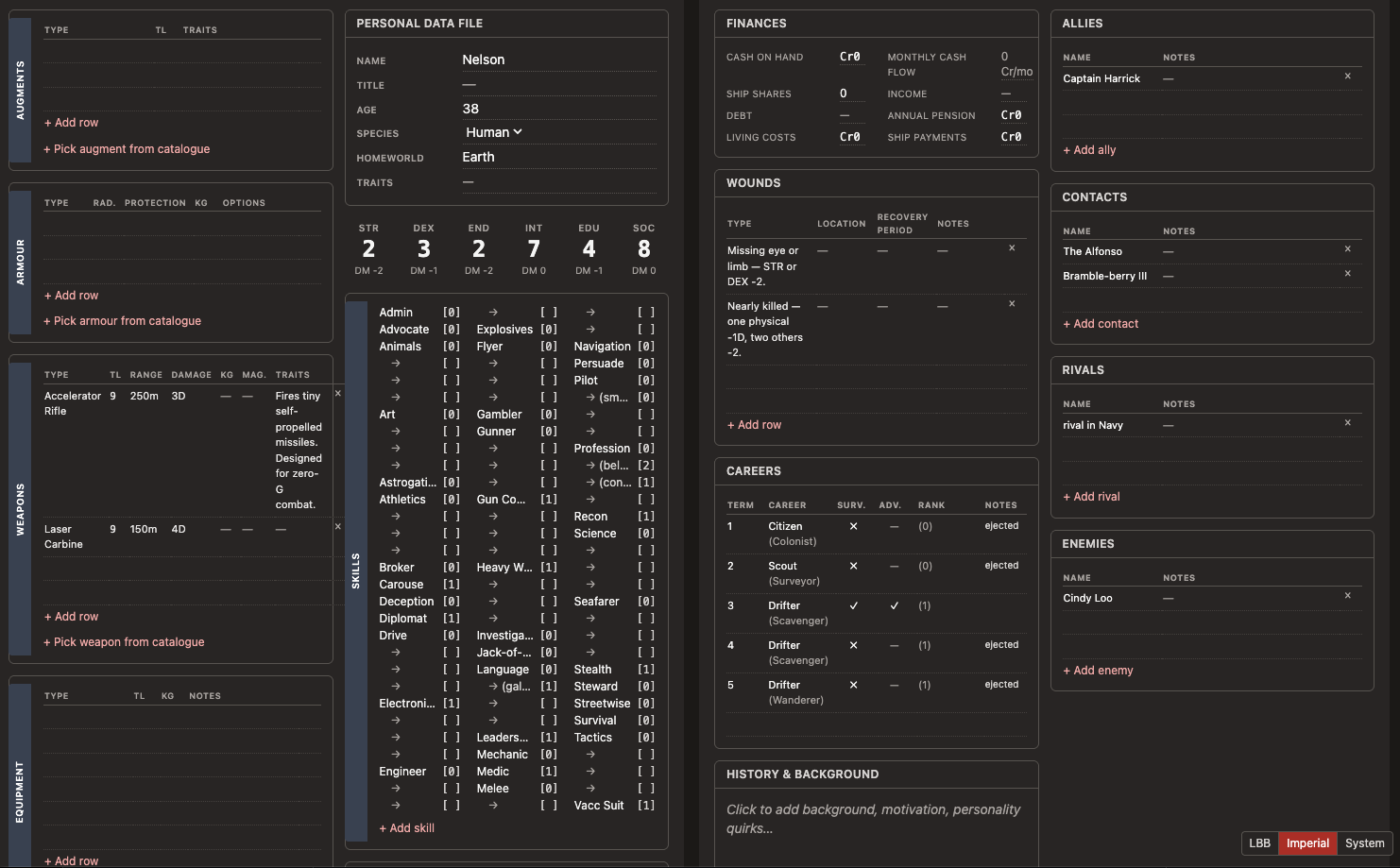
The character-creation rules are implemented as a typed effects engine — TypeScript discriminated unions with exhaustive switching — so every rule lives in one place and can be tested in isolation. The project ships with around 360 automated tests covering qualification, commission, advancement, aging crises, mishaps, life events, connections, the skill cap of 3 × (INT + EDU), pre-career education, and the Mongoose 2022 errata clarifications for Vargr and the Vacc Suit skill. A full audit trail of every rolled die, every applied DM, and every player choice is captured to a roll log that updates in real time. The post-creation sheet is a fully editable Mongoose-style character record. Skills, careers, equipment, weapons, armour, augments, connections, benefits, and free-form notes can all be edited inline; values save automatically to localStorage with cross-tab synchronisation, and the sheet is print-friendly (one panel per printed page, ink-friendly styling). Every character in the local library can be exported and re-imported as JSON for backup or for handing off between players.                                                      Two visual themes are included: a light "Little Black Books" look in the spirit of Classic Traveller, and a dark "Imperial" theme — plus a System mode that follows the operating system's light/dark preference and reacts live when it changes. Theme choice is remembered between sessions.                                                                    Accessibility is treated as a first-class concern. The interface meets WCAG 2.1 AA contrast requirements in both themes (verified by an axe-core audit suite that runs as part of the project's tooling), every interactive element has a visible keyboard focus indicator, icon-only buttons carry ARIA labels, and the layout includes a skip-to-content link for screen-reader users.           
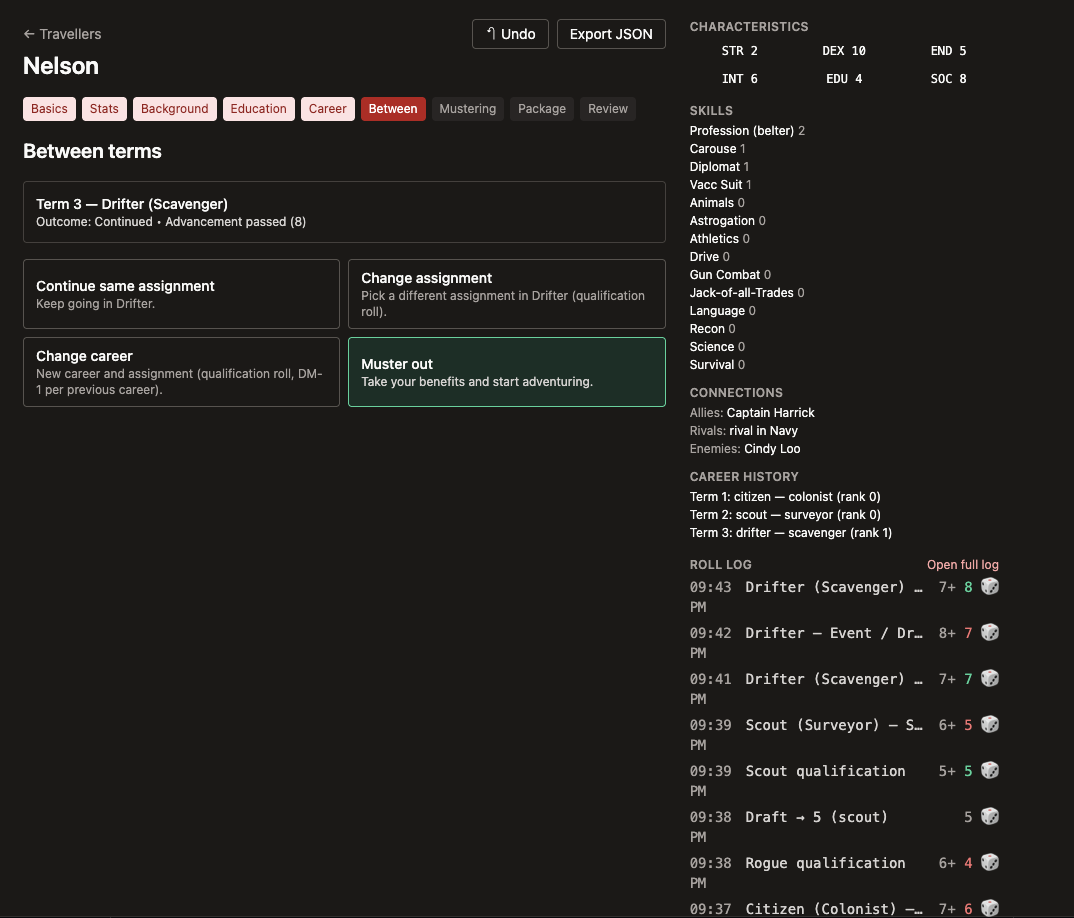
Other features include undo across the wizard (rewinds to the relevant picker after popping a character snapshot), URL-based debug logging (?debug=1), the Connections rule for shared PC backgrounds, an aging-crisis path with medical-debt accumulation, and an honest "unofficial fan tool" disclaimer in every place it matters.                            The project is open-source under the MIT License, runs entirely client-side with no backend and no account requirement, and uses privacy-friendly analytics (no cookies). Bug reports, rules questions, and pull requests are welcome on GitHub.

Links

bytesbynelson.github.io https://bytesbynelson.github.io/traveller-lifepath/ - Live tool github.com https://github.com/BytesByNelson/traveller-lifepath - Source code github.com https://github.com/BytesByNelson/traveller-lifepath/issues - Issue tracker / feedback

Reviews

Sorted by:

No reviews yet.

Login to leave a review.

Other entries

Talislanta
Tabletop Roleplaying Games

Talislanta

High-Fantasy
Rules-medium
Heroic
Talislanta is a fantasy tabletop roleplaying game created by Stephan Michael Sechi, first published by Bard Games in 1987. It draws its inspiration from Jack Vance's Dying Earth novels and the travelogue spirit of the Arabian Nights rather than from Tolkien. It built its identity around a single blunt promise printed right on the box: "no elves". No dwarves, no halflings, no standard-issue fantasy races at all - just dozens of original cultures found nowhere else in the genre.  The game has passed through five editions and nearly as many publishers, including a stint at Wizards of the Coast in the early '90s, and creator Stephan Michael Sechi now makes the entire back catalogue - every edition, every supplement - available for free through the official Talislanta Library. Description Playing Talislanta starts with a choice. Instead of creating a character from separate race, class, and skill lists, players pick one of well over a hundred archetypes. Things like the Cymrilan Rogue Magician, the Jaka Beastmaster, or the Mandalan Mystic Warrior - each one a fully realised character tied to a specific culture. Complete with attributes, skills, gear, and a place in the world already worked out. A little light customisation (a point moved here, a skill added there) and the character is ready to play.  What makes the game distinct isn't its mechanics, which are deliberately light, but the scale of its setting: the continent of Talislanta is home to more than a hundred distinct peoples, and the rulebooks spend far more pages on culture, custom, and worldview than on combat math. It rewards players who want to explore a genuinely alien fantasy world over chasing mechanical optimisation. System Overview & Key Features Archetype-Based Character Creation Character creation isn't a build process, it's a selection process. Every archetype in the book arrives fully statted, dressed, and equipped, tied to a named culture and a defined role in Talislantan society. Archetypes are deliberately unbalanced against one another, since staying true to the setting mattered more to Sechi than parity between character options. The Unified Action Table Skill checks, combat rolls, and magic all resolve on a single d20 chart. Attacking works exactly like any other skill roll: add a skill rating, compare to a target number. There's no separate combat subsystem to memorise, which keeps the rules themselves down to a few dozen pages even in the densest editions. Modes and Orders Magic runs on two interlocking pieces: Modes (twelve broad effect categories like Attack, Heal, or Illusion) and Orders (culturally rooted schools of magic, from Cartomancy to Elemental Magic). A magician's Order shapes how a Mode behaves and looks when cast, so the same underlying effect plays out completely differently in different hands - which lets a short list of Modes support a near-endless variety of actual spells. A World Built Without Tolkien Every culture in Talislanta was designed to avoid genre default: no elves, no generic barbarians, no standard dragons. In their place are peoples like the Thralls (identical clone-warriors distinguishable only by tattoo), the sky-sailing Phantasians, and the shapeshifting Sindarans. The setting material - not the rules - is where most of the page count and most of the game's reputation live. Links talislanta.com - Official Talislanta website talislanta.com/talislanta-library - Free official PDFs of every edition and supplement ever published

Read more

Rollplay
Tools & Platforms

Rollplay

English
Free
Paid
Rollplay lets you build your own mobile character sheet for whatever you're running. Drag & drop to create a layout, setup your own attributes and dice formulas, create items and conditions that actually update stats when your players use them. No code. Share the game and your table plays it on their phones. If you just wanna play one of the existing games, you can try some of the character sheets already in the app. D&D5e, Nimble and others await you to create characters, homebrew weapons or share your creations. Rollplay is built around automation, so homebrewing something ambitious doesn't mean a spreadsheet full of manual math. Design a race, class, item, or a whole new system: set the rules once and let the app run them. Share it with your table, and your players don't have to learn your system to enjoy it; they just play, while your rules quietly do the work behind the scenes. It's the easiest way to make your homebrew feel as polished as anything official.  For Players Auto-Calculated Attributes Stats update automatically as you level up, equip gear, or gain new abilities. Automated Effects Items, classes, and conditions modify your stats on their own, and unwind cleanly when removed, even through deeply nested chains. Equipment & Inventory Equip and manage items in one place, with carry weight and currency tracked for you. 3D Dice Roller Roll skill checks and weapon hits with a single tap, with explosive dice, rerolls, and advanced roll mechanics. For Creators No-Code System Creation Build a complete custom game system: attributes, formulas, effects, dice, and content, no programming needed. Custom Rules Define your own attributes, dice pools, and formulas. Rename core concepts like Race or Ancestry to match your setting. Drag & Drop Sheet Builder Design your character sheet layout visually with modular building blocks. Share & Iterate Push your system to your players directly, with draft and published versions so you can update it without breaking their games. Links daydreamteam.com - Official website play.google.com - App on Google Play apps.apple.com - App on App Store discord.gg - Discord server patreon.com - Support the project reddit.com - r/Rollplay_app subreddit

Read more

Geek Native
Blogs

Geek Native

TTRPG
English
Discussions
Geek Native is an independent news site and community for tabletop roleplaying games, board games, anime, and geek culture. It covers tabletop mechanics, industry news, and reviews with a critical but welcoming tone. Whether you’re a player, a Game Master, or somewhere in between, it’s a solid place to find content that actually holds up. It also publishes practical tools for session prep and world-building -  things like spaceship name generators and lists of oddly unsettling phrases to throw at your players. Alongside those, there are columns on the psychology of gameplay and table dynamics. It’s been around long enough to build a genuine community, and it shows. Links geeknative.com - Website

Read more

Looking for a group?

Find a tabletop group to join or players to invite. Groupfinder is a free looking-for-group platform. By players, for players.