“
Covering the basics  https://groupfinder.eu/library?category=guides-how-to&search=f1=133
” is a easy-to-follow set of articles helping players get through the first steps of the game. You found a game to join? Well done, but now what?
Short answer: yes
Long answer: You might’ve spent most of your games on the other side of the DM screen or watching people masterfully direct their games on Youtube. All this might seem like a daunting and difficult role to fill - all the rules, ruling, voices, worldbuilding and keeping track of everything that is going on. Feels a lot for one person to manage.
But here is the honest truth - most DMs are mostly just “winging it” as they go. They might not know every rule in the book or have every alleyway and farmhouse carefully plotted with intricate details for the world their players roam around. You don’t have to be a master of the game to be a dungeon master. It’s just a title, it doesn’t mean they know what they are doing.
The context effect
You may have watched various expert Dungeon Masters on different streams or Youtube actual plays. And thought that this is the minimum skillset you should have to even dare to take up the role of a DM.
But keep in mind, context matters. These shows do not represent your average players or DMs. These are professional productions featuring professional actors. Your players are not expecting a cinematic masterpiece with custom miniatures, terrain or orchestral soundtrack.
They are your friends, either new or old. And they just want to hang out, eat snacks, tell stupid jokes and see what happens when they push too many buttons. Don’t compare yourself to others, whether they are your last DM, or someone on Youtube. Your style will be your own. And your mistakes will be part of your journey.
You are there to react to their actions and tell them what happens next. That’s it. If your players end the game session feeling happy with how they spent their time, you’ve won as a DM.
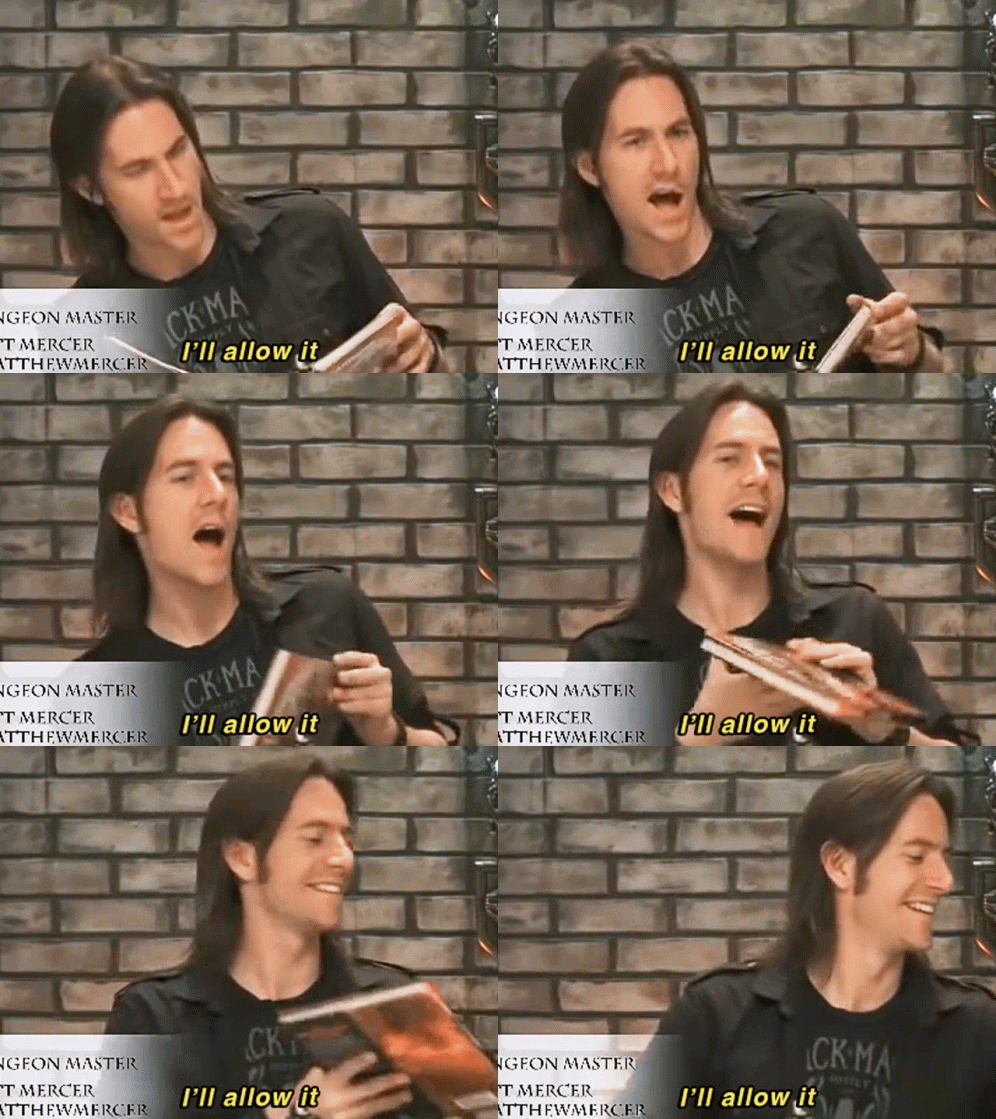
It is your game, as long as your players are enjoying it, you are winning
Start small
It is easy to fall into the pit trap of building your own epic world for the players to discover and enjoy. And while there is nothing inherently wrong with it, it would be better to start off small. You will reduce the amount of stress and headache you will endure by not preparing a 50-page lore document beforehand.
Instead, consider running a oneshot. A self-contained short adventure, that starts and ends within one session. You will gather your bearings during the game, realize what parts of DMing you enjoy and what you would rather not focus too much on.
Use a pre-written adventure. For D&D, you could look towards
The Delian Tomb https://www.dmsguild.com/en/product/241073/the-delian-tomb or
A Most Potent Brew https://www.dmsguild.com/en/product/186488/a-most-potent-brew-a-basic-rules-adventure. These include maps, monsters and all the relevant knowledge you need to run your players a game. Or grab one of the starter sets (ex.
Heroes of the Borderlands https://www.dndbeyond.com/en/heroes) and run that. Make sure that you understand the whole story beforehand, so you know where the story is supposed to go.
If, however, you feel like creating something of your own, you can simply build a oneshot that follows some specific rules.
Entrance: A puzzle or a simple monster fight to get the players involved.
Cause: A situation to tie the players’ characters to the story. A clear call to action to guide the characters towards the end-goal of the adventure.
Problem: With the goal set, present your adventurers with a situation that requires them to overcome it. Whether by brute force, thinking outside the box, or something completely different. Here’s a DMing secret: You can have your players face a situation that needs solving but as a DM, you do not have to know what the right solution to that needs to be. Let your players attempt different approaches and if they come up with something that seems reasonable, take that as the solution.
Final encounter: Your oneshot should be leading towards a finale. Whether it is a boss fight, or a grand puzzle or situation that requires effort and teamwork - anything goes. It should be connected to the previous blocks to establish a cohesive narrative story.
The ending (optional): Once the final encounter has been resolved, you can offer your adventurers a conclusion, perhaps it is a treasure hoard, public praise or something different. Since it is a oneshot, you don’t really have to worry about consequences, as the story ends there.
Keep in mind, that oneshots should be reactive. Players should be forced to react to situations and not given too much time to wander around, chat with Boblin the Goblin at the tavern, or get bogged down with planning.
A good idea would be to have some pre-made NPCs in the background, so you can pull those up at moments notice. These characters should not have intricate backstories that aren’t vital to the story itself. They may have a simple motive or goal, that can support the story at hand, but isn’t a vital piece of information, should your players completely ignore or miss encountering them.
You can use a name generator (like
Fantasy Name Generators https://groupfinder.eu/library/fantasy-name-generators ) to prepare a list of various names to make it seem, like you had those characters prepared and planned ahead of time.
Pace over rules
Nothing kills the vibe of the game than having to spend ten minutes looking for the correct ruling for a situation. As a rule of thumb, it is recommended to spend up to a minute looking up the rules - and if by then you don’t have the correct answer, make a ruling on the spot. Just be transparent about it and let them know that this ruling might be wrong and is temporary, in the future this might get ruled differently. But for now, to keep the story going, you should decide on the spot.
If you have a more experienced player at the table, consult them. As a DM you are already managing way more than one single player should be (you are still a player, even though you are a DM). And offloading some of those responsibilities to someone else is the right thing to do. The DM does not have to be the most knowledgeable player at the table - they are the narrative engine, not the wikipedia.
Don't spend too much time
pondering the orb finding the correct ruling, keep the game going
A session zero
It is highly recommended to have a quick session zero before starting your first game. Whether it is a brief oneshot or the start of a longer campaign - leveling with your group will help you avoid misunderstandings in the future.
Recommended reading: Library: Session 0 checklist: How to build a DnD group that lasts https://groupfinder.eu/library/session-0-checklist-how-to-build-a-dnd-group-that-lasts
Gather your tools
Now prepare your adventure. You will most likely spend a lot more time than you should preparing for the first session. But being somewhat overprepared will help you in the long run. Once you start understanding how DMing works, you will get better at preparing for each session, eventually cutting down on the time spent on prep.
A DM trick worth remembering and learning, is called “
moving castles”.
You may have prepared a location or an encounter for your players to discover or run into. But through the magic of player agency they head in the complete opposite direction to your prepared piece of content (it happens). Instead of scrapping the work you have prepared, you can simply move it, so that the adventurers still run into it.
A worn-down castle filled with a tribe of goblins, waiting to ambush anyone entering the front gate? Simply move it, perhaps adjust some elements to fit the new location. Instead of goblins, they are now human mercenaries or bandits. Instead of a castle, it is a small village.
This isn’t to say, that you should focus on railroading the players (although for a oneshot it would be highly recommended, that you keep your players on the track you have prepared). But re-using prepared content in a new and appropriate way is the smart play.
Other than that, all you need to get started, are your dice (or digital dice, if that is more convenient for you), and some paper, to write down notes, events and questions for you to look up between sessions.
Remember, you are a player too. You should be having fun, although it will feel intimidating and stressful at first, it will get better.
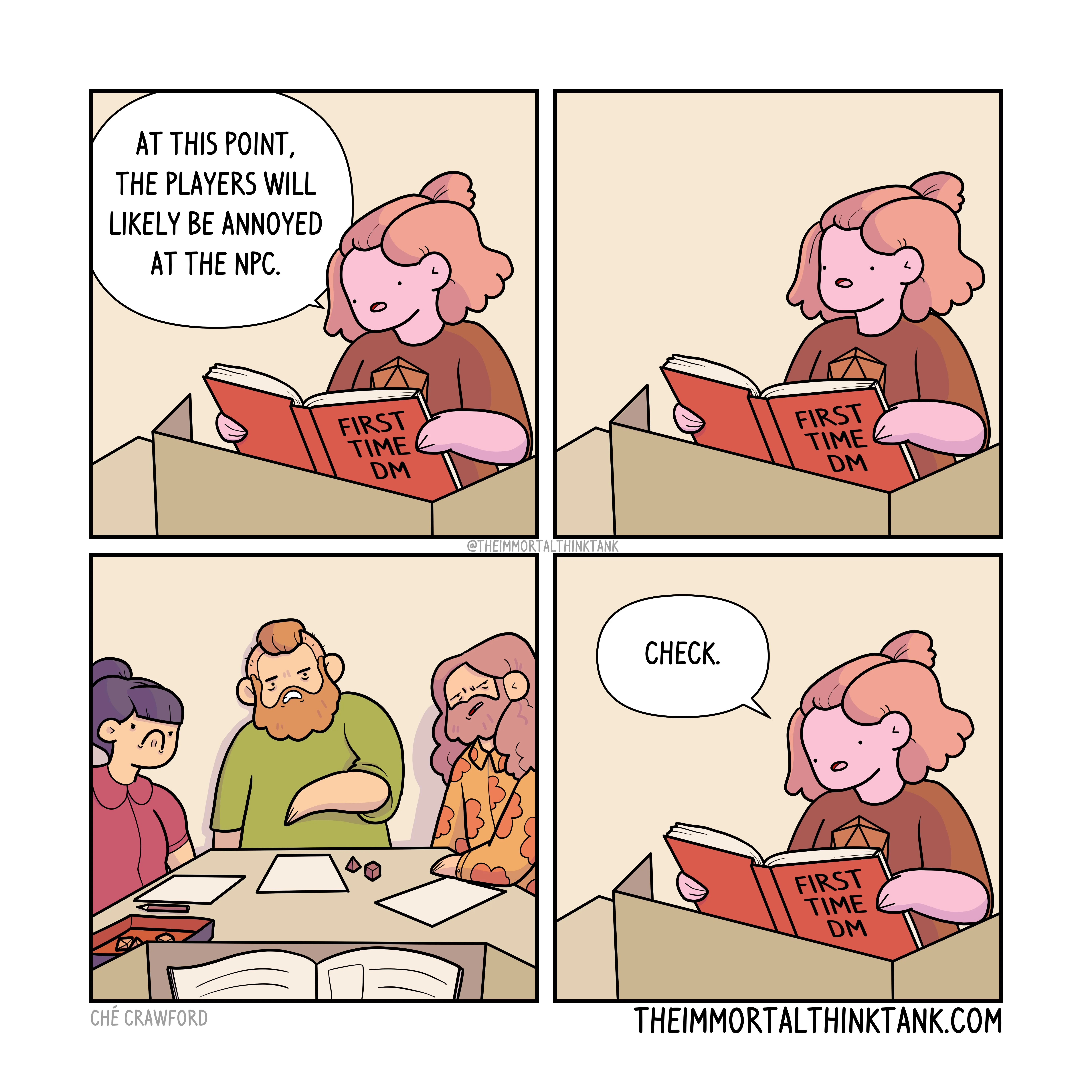
Take the leap
You are stepping into a very rewarding experience of the game. Even if you are not planning on becoming a recurring DM, you will gain a better understanding of the game and the system. This will, in turn, make you a better player. Guaranteed.
If you are ready to give DMing a shot, you can start off by
creating a group https://groupfinder.eu/addgroup on Groupfinder and find your players. Be sure to use the “
Newbie friendly” tag to indicate the tone of the game.
If you have a player in your group who has been interested in DMing, but has not had the courage to get started - “gently” send them this article, to nudge them to get started.